
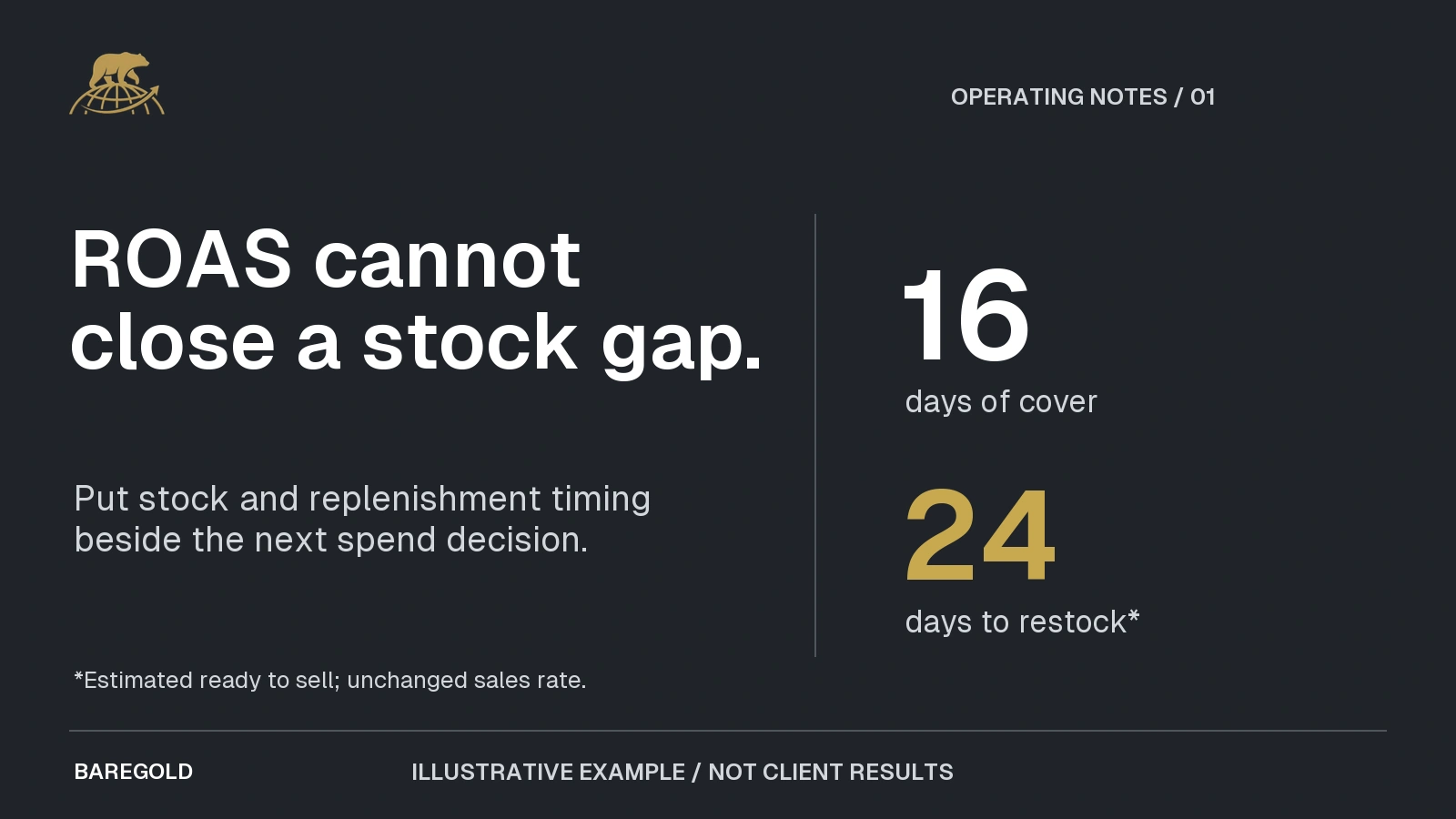
A serum campaign can meet its ROAS target while the product heads toward an empty offer. The advertising report describes one part of the business. The next budget decision also needs the stock position and the date the next batch is expected to be ready to sell.
That connection is the point of stock-aware advertising: bring inventory constraints into the spending decision early enough for an operator to do something useful with them.
Start before the out-of-stock event
Amazon says Sponsored Products appear only when the advertised items are in stock. That is a current eligibility condition for this ad format. It does not answer the planning question: how much demand should we try to generate while replenishment is still weeks away? Amazon Ads: Sponsored Products
For a health or beauty brand, that question belongs to the same product, pack and marketplace. A total across different packs or locations can give the wrong impression of what is available for the advertised offer. Where batches have date or eligibility constraints, check which units are usable for that plan separately. This example does not establish any product's marketplace eligibility.
Work through one fictional serum SKU
Assume there are 320 units ready to sell, recent total sales are 20 units per day, and replenishment is estimated to be ready to sell in 24 days. There is no other usable replenishment in the model.
Simple stock cover is 320 ÷ 20 = 16 days. At that unchanged sales rate, there is an eight-day gap before the next batch is expected to be ready. These are planning calculations, not a prediction of demand or a promise about when stock will run out.
Now choose an 80-unit buffer. That is an operator's assumption for this example, not a recommended universal safety-stock level. The planning capacity through replenishment becomes:
(320 sellable units − 80 buffer units) ÷ 24 days = 10 total units per day.
“Total” matters. Those ten units must accommodate all modeled sales of this SKU. They are not an allowance for ten sales attributed to advertising on top of other demand. They are also not a ten-dollar daily budget. Nothing in that division tells you how many additional sales a dollar of advertising will cause.
All numbers are illustrative, not client data or measured results. The model assumes consistent units, the same SKU and market, a constant sales rate for the cover calculation, and that the replenishment estimate holds.
Make the stock input usable
The first job is to distinguish inventory states. Amazon's FBA Inventory API describes fulfillable, inbound, reserved, unfulfillable and researching quantities. They represent different situations; adding them into one apparently available number can conceal the decision. Fulfillable inventory is described as stock that can be picked, packed and shipped. Inbound is stock on its way to the network. Amazon: FBA Inventory API
For the planning view, keep the quantity's source and update time alongside it. Keep the expected ready-to-sell date separate from the supplier's dispatch date or a delivery scan. The API's inventory states do not, on their own, establish when future stock will be ready to sell.
A failed refresh should leave the last successful value visibly dated. It should not make an old stock figure look current. If the restock estimate is unknown, show that uncertainty instead of silently borrowing a shipping date.
Decide what to do about spend
The 10-unit figure is a constraint to investigate. Before increasing the budget, review three things together:
- Demand without the proposed increase. Would existing demand still consume stock too quickly? Pausing advertising cannot be assumed to remove enough demand. Do not treat total sales minus ad-attributed sales as a measured no-ad baseline.
- The economics of the next sale. Product costs and margin still matter. Stock cover alone cannot choose a bid, targeting change or profitable budget.
- The replenishment options. Can usable inventory become ready sooner? Is the estimate still credible? Faster dispatch only helps if it changes when the correct units can sell.
One sensible operating rule is to flag a proposed budget increase when the stock plan cannot support it. Use that flag to trigger a current demand and replenishment review, then decide what to change. A blanket pause on every campaign can miss the underlying supply problem.
What BareGold brings to the connection
BareGold focuses on the systems behind Amazon operations for health and beauty brands. The useful output here is a spending decision informed by current stock, product economics and replenishment timing, with assumptions visible.
Bring the next budget increase and the next ready-to-sell date into the same review. If those decisions currently happen in separate files, that is a practical place to begin.
Talk to BareGold about connecting inventory and advertising. Our separate free public Amazon check does not inspect private PPC or inventory systems.